Affichage des articles dont le libellé est future. Afficher tous les articles

lundi, juin 24, 2013

How bitcoin may be already crumbling under its own success


The bitcoin community has recently discussed about government interference, but today, I want to discuss 2 mostly overlooked bitcoin news:
 * blockchain has reached a size of 8 Gb
 * transactions shall have, now, a minimum size

 These 2 events/news are closely related. Every transaction contributes to the 8Gb ledger size, and "they (the miners?)" want to limit the ledger size. This will be done by fighting transaction spam i.e. eliminating insignifiant exchanges and non-financial transactions such as those initiated by satoshidice.

Why is it needed to limit transactions when there are so few users?
Is limiting transactions today a sign that bitcoin will not scale well?

Some predict that bitcoin market capitalization will reach orders tens, hundred of billions or even trillions.
 * How many people will use bitcoins in a few years?
 * What will be, then, the size of the bitcoin ledger? Will it still be manageable? 

Most probably to keep the ledger at a computable size, transaction size will be limited to higher limits. People will be less able to use it, then, for day to day transactions, if the limit is set to 0.1 bitcoin (equivalent to 100$?) for instance.

Maybe are we going to need to use other currencies, for smaller amounts, such as litecoin sometimes deemed as "silver compared to bitcoin's gold"? If "open currencies" become mainstream, I guess in addition to gold and silver, copper, iron, lead and feather coins are going to be needed to be able to manage the huge number of transactions when half the planet is going to use these new currencies.

Today's amount of transfers is looking like ripples compared to tomorrow's tsunamis of transactions. If we consider bitcoin as the "Napster" of open currencies and expect future open currencies, answering to those questions, which I personnally find unsolved yet, is something essential.

Or ... did I miss something?
A few weeks ago, I understood that maybe oldest parts of the ledger will be dropped. When will that happen?

 Anyway the amount of transactions is already a problem because today  "they" feel they should limit the number of transactions.

mercredi, février 24, 2010

Future of Requirement Management Tools

I've been looking at Requirement Management tools for 5 years now.

Requirement Management tools are all evolving towards a common view. They now offer the same kind of functionalities, in a similar way.

For instance, a few years ago, for most of the tools, the way to present requirements was only available as a list of requirements title. To look at the requirements details, you had to click on the specific requirement.
Now most of them, are offering a "word document view", where requirements can be displayed as a word document with chapters.

In the future, my feeling, is that what will be important is, not the functionalities offered by the tool itself, but the level of integration with test management, change/bug management and code source file management tools.

One of the main functionality of a Requirement Management tool is traceability. Traceability between marketing and technical requirements and specifications. This is today handled correctly by most RM tools, but an advantage comes when you can also link requirements with tests and build some test coverage tools for instance.

And we can go further by extending tracceability to changes/bugs and even source file.

Here is a view that summarizes my point:

One of CMMI Requirement Management specific practice says: ["SP 1.4 Maintain Bidirectional Traceability of Requirements" - Maintain bidirectional traceability among the requirements and work products.].
Using closely linked/integrated test management, change/bug management and code source file management tools is an "easy" way to achieve this goal.

mardi, janvier 15, 2008

Technical innovations until 2030


Here are some technical innovations projected by some "Young Global Leaders".

A bad new for the keyboards I build: "full voice interaction with PC"

Some questions:
  • What the hell means "Virtual Holydays"? Does that nean "No Holidays"?
  • What is a "Dream Machine"? A machine connected to your brain that "downloads" dreams into your head? Or a machine so beautiful or efficient that you can't do anything but wondering how marvelous the world has become?
  • "Computers that write most of their software": Thi is not a progress. That already exists today, and it does not work that well.
Here is the one I am waiting for: "Fully auto-piloted cars"

mercredi, juin 13, 2007

What will be the successor of the current user (professional) profile in online networks?

This question has been asked in LinkedIn Q&A forum Ronald Wopereis.

Ronald Wopereis asks: "Currently every major online social and/or business network has this concept called "user profile". The information inside such profile would hardly be considered factual by any news reporter or judge. Clearly, our presentation of ourselves is biased, aimed at offering a certain kind of contact while at the same time making sure that our shadow elements are left out as "not really relevant at this stage of relationship building".

In my theory of attention, and following Spinoza's comments 300 years ago that mind and body are two perspectives on one and the same area, i see a future where software usage is what builds a user profile."

My answer is: I guess LinkedIn is pioneering the "successor of (professional) user profile" with 3 specific features:
  1. who you know - your network
  2. recommendations from current and past colleagues
  3. LinkedIn Q&A feature where you can advertize your skills by asking and answering question. from what I understand this is what you call "software usage".

In addition to what's on LinkedIn, as Ronald wrote it, every name can be "googled". That's why in addition to Linkedin Q&A, it's a good practice to participate to forums and publish some papers.

Read also: GROW YOUR NETWORK WHILE YOU DON'T NEED IT!

vendredi, octobre 13, 2006

My last IBM meeting: a new concept

Years ago, I was a proud IBMer in Corbeil (FR), RTP (USA) and La Gaude (FR).

A few weeks ago, I was invited to “The Greater IBM Connection” here , here or even better here.

“The Greater IBM Connection” is a bunch of IBMers and ex-IBMers who wish to connect, communicate and collaborate.

As you may be aware, IBM was and is still present in a lot of countries around the world. As IBM alumnis, as we call ourselves, wanted to meet and not just communicate through emails and blogs, some face to face meetings were set up in various cities. I always refused the invitations as these meetings were taking place too far from where I now live and work (France and Switzerland).

Then came another invitation taking place at first sight in New-York. I told myself, “yet another one, I’ll have to decline”. Then on second sight, I read that it took place here on a website named Second Life…

I want to share here my experience at this meeting (Oct 12th, 2006) with you and invite you to “The Greater IBM Connection” if you are or were a proud IBMer. This was for me the first concrete result from participating to the “The Greater IBM Connection”: discovering and living a new concept.

First of all I had to register on SL (2ndlife) create an Avatar (an image of myself in SL), learn to move and interact with the world and other avatars through SL IM (instant messaging). Then you modify your appearance (clothing, hairs, etc…). After half an hour you’re set, ready to second live.

The Meeting

A few days later I went to the meeting, a specific place on SL, by teleporting. By the way, you can also fly in SL which is a great experience. I was welcomed by the organizers, and the meeting took place there.

In addition to being there in the SL meeting room, we had to be also on a conference call on the regular phone.

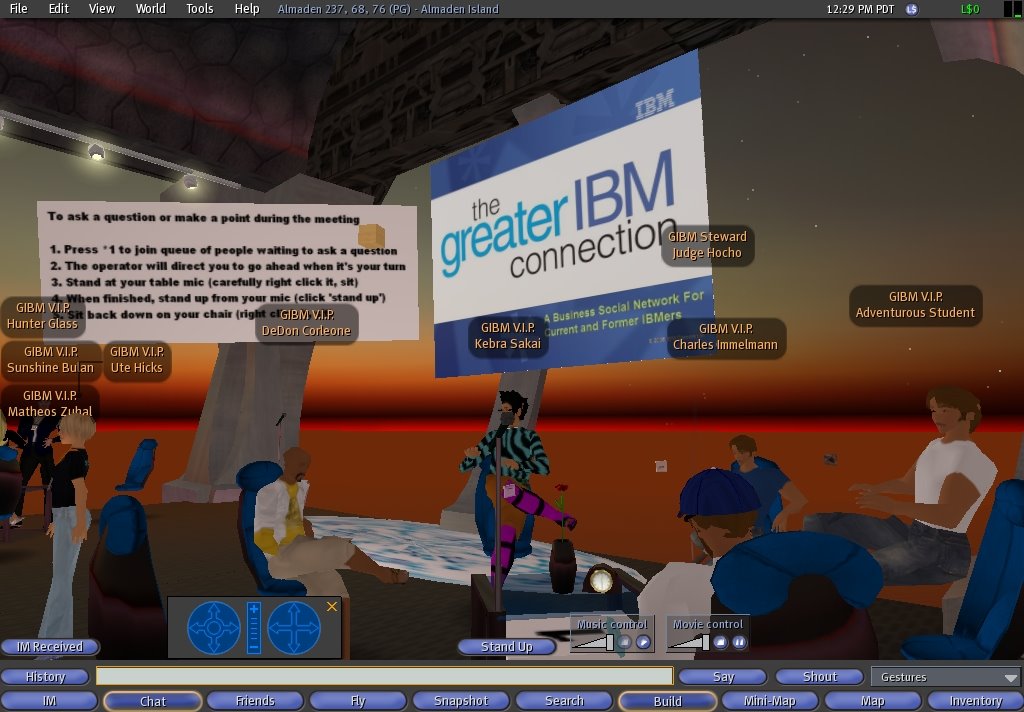
We first had some powerpoint presentations commented on the phone by various people as seen on the snapshot I took during the meeting. In SL I’m “Kebra Sakai” with the turquoise zebra shirt, listening carefully and staring at the greaterIBM slide…


Questions could be asked through the phone.

Then we gathered in small focus groups around tables discussing some specific topics. To communicate around the tables we used IM shared by table rather than the phone, to discriminate between discussion groups.


The last phase of the meeting was spent doing direct IM communication two by two to know specific peoples.

After two hours I left the meeting and teleported elsewhere after a flight around the meeting building.

Conclusion

We’re still at dawn of such practices:

  • We still need a regular phone for conference calls to be able to listen to people.
  • We have sometimes difficulties to master the interface to interact with SL.
  • We are just not used to attend meetings this way.

But it makes these kind of meetings more lively than conf calls with a netmeeting presentation. From my point of view this is especially important when you meet people for the 1st time.

I guess it is going to be more and more common to have such meetings who bring some second life to today’s meeting.

By joining “The Greater IBM Connection”, I hope to participate to such other meetings and discover some revolutionary concepts such as this one.

please find other blogposts on this specific subject here.

Technorati tag this: ,